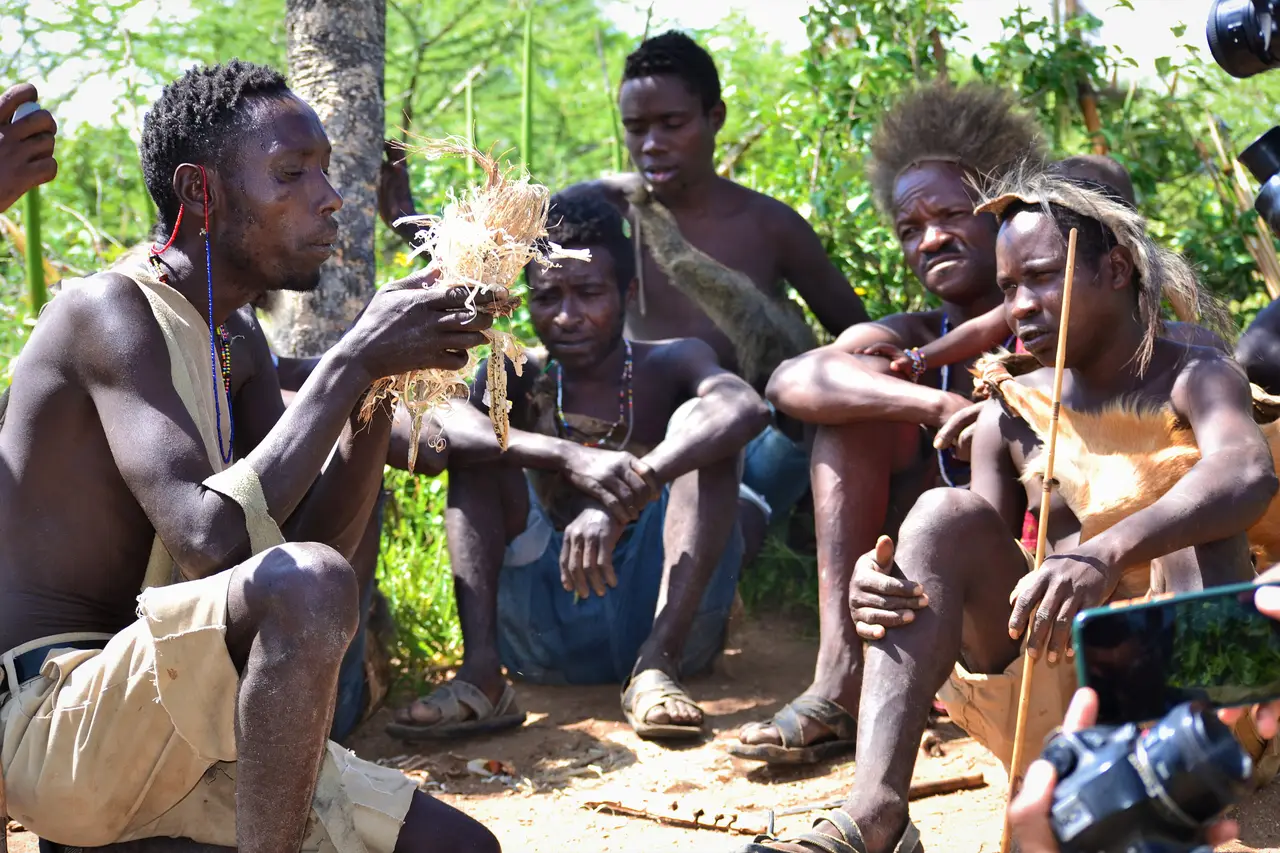
They live south-east of the Ngorongoro highlands, around Lake Eyasi, in small groups of about twenty people. They speak Hadzane, a language with click sounds that is not known to be related to any other. They practise neither farming, nor herding, nor metalworking.
How they live
They hunt with bow and arrow, often at dawn, and gather berries, tubers and wild honey. They do not accumulate possessions and have no formal hierarchies: decisions are made through discussion. Camps move to follow the resources.
The same region is home to the Datoga, herders originally from the Horn of Africa, who work metal and trade arrowheads with the Hadzabe in exchange for hides and honey.
A visit to be done well, or not at all
This is the most delicate point. A dawn hunt with them can be an authentic experience, or a paid performance repeated four times a day. The difference lies in the number of visitors, the time of day and who receives the money.
We go early, in small groups and through local contacts who have worked with the same families for years. If the conditions are not right, we would rather not offer it.
Why it matters
They represent a way of being in the world that predates agriculture, and that today survives among a few hundred people. Their land is steadily being eroded by herding and cultivation. Seeing them is not looking at the past: it is looking at a choice that endures.