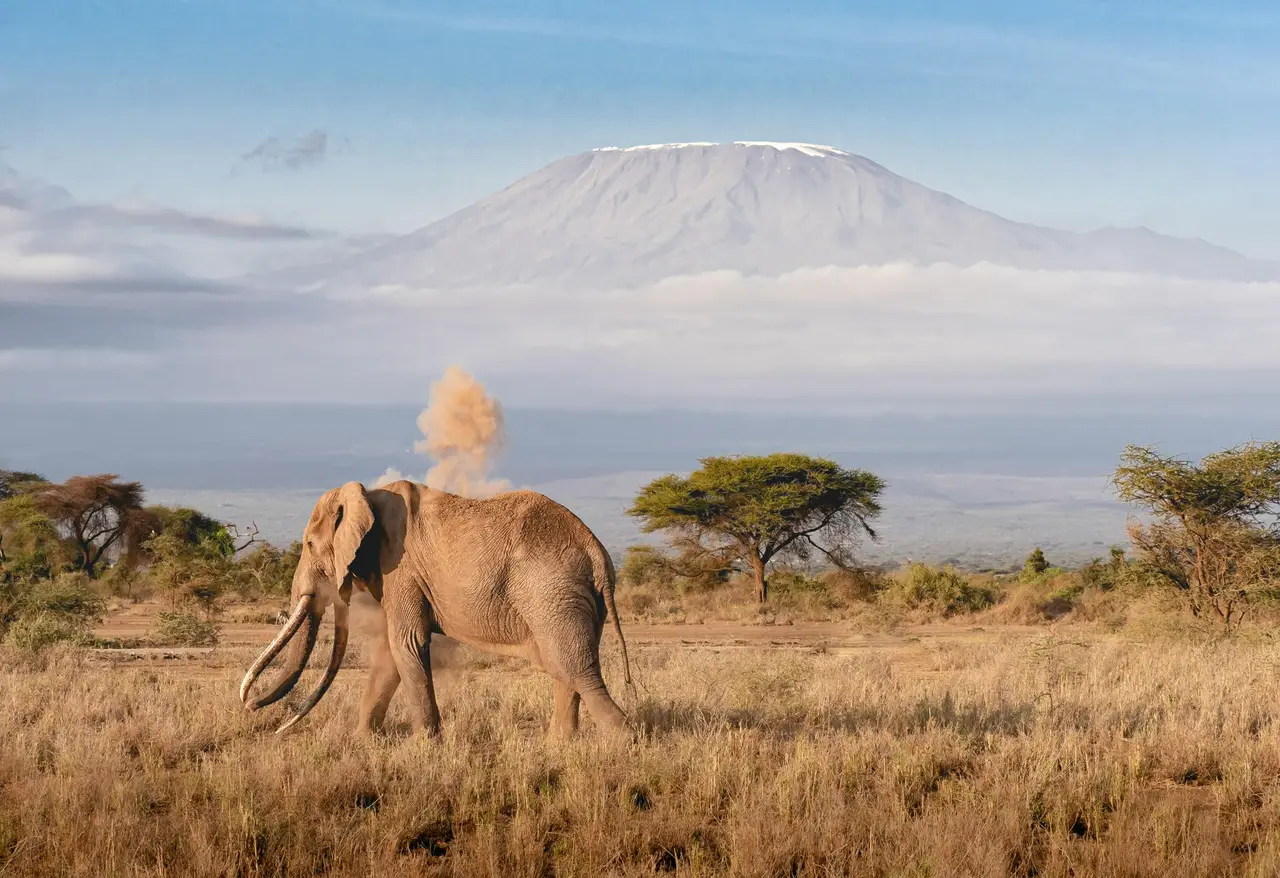
Kilimanjaro does not belong to a range: it rises alone from the plain, a volcano with three cones. Kibo, the highest, reaches 5,895 metres at Uhuru Peak, which means freedom in Swahili; Mawenzi reaches 5,149 metres, Shira 3,962. From the savannah of Amboseli, in Kenya, its silhouette is one of the most recognisable images of the continent.
Who climbed it first
The first documented ascent was on 6 October 1889: the German geographer Hans Meyer and the Austrian mountaineer Ludwig Purtscheller, with Yohani Kinyala Lauwo, a guide from Marangu whose name was long left on the margins of the story.
The climb
You need neither ropes nor mountaineering experience, but altitude is the real obstacle: altitude sickness strikes regardless of fitness and can become dangerous. That is why the number of days matters more than the effort: the more time you allow for acclimatisation, the greater your chances of reaching the top.
There are seven routes: Marangu, the only one with huts, Machame, Lemosho, Shira, Rongai, the Northern Circuit and Umbwe. The climb is made with licensed guides.
Several climates in a single climb
You set off among farmland and montane forest, cross moorland with giant groundsels, including a species found only here, then high-altitude desert up to the glacial zone of the summit. The Chagga live and farm on the lower slopes.
The vanishing ice
Between 1912 and 2009 the ice cap shrank from about 12 to 1.85 km², a loss of around 85%. The snows of Kilimanjaro are one of the images most often cited when discussing climate change in Africa.
When to go
The driest periods are January to early March and June to October. April and May, with the long rains, are the most difficult months; November brings the short rains. Find out more in when to go to Africa.